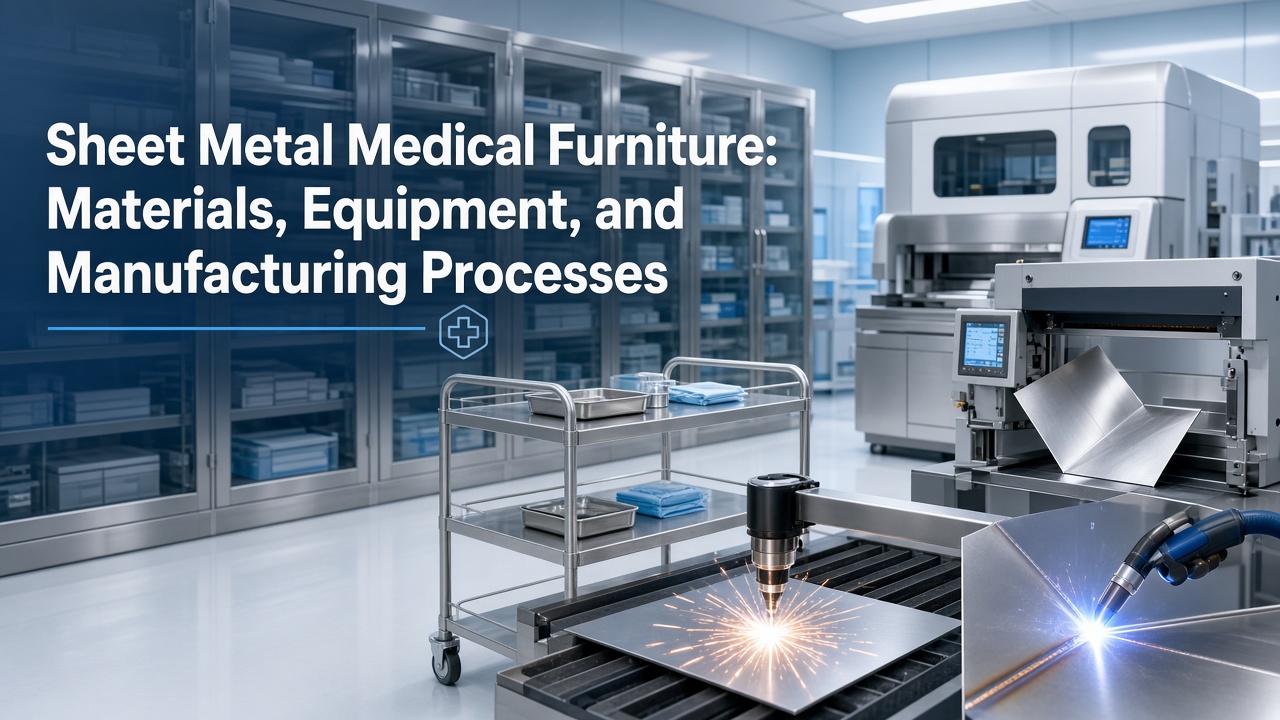
Sheet metal fabrication plays a central role in producing durable, hygienic furniture and equipment for hospitals, clinics, laboratories, and operating rooms. Common products include instrument cabinets, medicine cabinets, bedside cabinets, medical carts and trolleys, equipment housings, workstations, sterilization trays, and structural frames for beds or stretchers. The choice of material, processing equipment, and manufacturing sequence is driven by the need for corrosion resistance, easy cleanability, mechanical strength, and compliance with healthcare hygiene standards.
Materials Used in Sheet Metal Medical Furniture
Material selection depends on the intended environment (critical sterile zones versus general patient areas), exposure to disinfectants, required strength, weight constraints, and total cost of ownership.
Stainless Steel
Stainless steel is the preferred material for high-hygiene applications. The most commonly used grades are:
- 304 stainless steel (AISI 304 / 18-8): Offers good general corrosion resistance, excellent formability, and broad availability. It is widely used for cabinets, carts, racks, examination-room furniture, and many non-critical or dry-zone components.
- 316 and 316L stainless steel: Contain molybdenum (typically 2–3%), which significantly improves resistance to pitting and crevice corrosion from chloride-based disinfectants and other aggressive cleaning agents. 316L (low-carbon version) is preferred when welding is involved because it reduces the risk of sensitization and weld decay. These grades are favored for operating rooms, intensive care units, sterile processing areas, instrument trays, and wet or chemical-exposure zones.
Stainless steel surfaces are typically finished by brushing (#4 satin), polishing, or electropolishing, and they are often passivated to restore the protective chromium-oxide layer. The material is non-porous, resists most hospital chemicals, and supports repeated cleaning and sterilization without coating degradation.
Powder-Coated Mild Steel (Carbon / Cold-Rolled Steel)
Mild steel or cold-rolled steel is frequently used for structural frames, cabinets, and furniture in lower-risk areas such as general wards, outpatient clinics, administrative spaces, and support zones. After fabrication, the steel is powder-coated (commonly epoxy or polyester systems) to provide corrosion protection, impact resistance, and aesthetic color options.
This approach is more economical than stainless steel for large volumes or less demanding environments. However, the coating can be compromised by deep scratches or prolonged exposure to aggressive chemicals, potentially allowing corrosion or harboring contaminants. It is generally avoided in operating rooms and other critical sterile zones.
Aluminum Alloys
Aluminum (primarily 5052 and, to a lesser extent, 6061) is chosen when weight reduction is important. It offers good formability, natural corrosion resistance via its oxide layer, and excellent strength-to-weight ratio. Typical applications include lightweight equipment housings, covers, panels, mobile cart components, and certain chassis.
For medical use, aluminum usually receives anodizing or powder coating to improve chemical resistance and surface hardness. It is less common for primary load-bearing furniture that must withstand heavy mechanical abuse or the harshest disinfectants compared with stainless steel.
Material Comparison
| Characteristic | 304 Stainless Steel | 316 / 316L Stainless Steel | Powder-Coated Mild Steel | Aluminum (5052) |
|---|---|---|---|---|
| Corrosion resistance | Good | Excellent (especially chlorides) | Moderate (depends on coating) | Good (with proper finish) |
| Hygiene / cleanability | Excellent | Excellent | Good | Good |
| Strength & durability | High | High | High | Moderate to high |
| Weight | Heavy | Heavy | Heavy | Lightweight |
| Typical cost | Moderate | Higher | Lower | Moderate |
| Best suited for | General medical furniture, cabinets, carts | ORs, ICUs, sterile processing, trays | General wards, support areas, cost-sensitive projects | Lightweight housings, mobile components |
| Lifecycle considerations | Long service life, low maintenance | Longest life in harsh environments | Lower upfront cost; coating maintenance required | Weight advantage; finish care needed |
In practice, many manufacturers combine materials—for example, stainless steel for contact surfaces or critical frames and powder-coated steel or aluminum for less exposed structural elements—to balance performance and cost.
Equipment Used in Manufacturing
Production of sheet metal medical furniture relies on precision CNC equipment to achieve the tight tolerances, clean edges, and consistent quality required in healthcare environments.
Cutting and Blanking Equipment
- Fiber laser cutting machines: The dominant technology for medical sheet metal. They produce clean, precise contours, intricate features (slots, holes, ventilation patterns), and minimal heat-affected zones.
- CNC turret punch presses / punching machines: Used for high-volume perforation, standard hole patterns, and forming operations such as louvers or embosses. Often combined with laser systems in hybrid cells.
- Shears and notching machines: Employed for simpler rectangular blanks or secondary cutting.
Forming and Bending Equipment
- CNC press brakes: Essential for accurate bending of panels, cabinets, trays, and structural parts. Modern machines include crowning systems and angle measurement for repeatability (often within ±0.5°).
- Panel benders: Increasingly used for box-shaped housings and cabinets because they deliver high consistency and reduced operator dependency.
- Tube benders and tube laser cutters: Critical for frames of carts, trolleys, beds, and stretchers, where tubular stainless steel or steel sections are common.
Joining Equipment
- TIG (GTAW) welding machines: Preferred for stainless steel medical work because they produce clean, controllable welds with minimal distortion and spatter.
- Laser welding systems: Offer narrow heat-affected zones, low distortion, and high-quality sanitary seams; increasingly popular for medical applications.
- MIG welding and spot/resistance welding: Used for selected structural joints or high-volume mild-steel components where cosmetic finish is less critical.
Finishing and Quality Equipment
- Deburring and edge-rounding machines (to eliminate sharp edges that could damage gloves or trap contaminants).
- Grinding, polishing, and electropolishing lines (especially for stainless steel).
- Passivation equipment or tanks.
- Powder-coating lines (pretreatment, spray, and curing ovens).
- Coordinate measuring machines (CMM), height gauges, and surface-roughness testers for dimensional and finish inspection.
Manufacturing Process Flow
The typical fabrication sequence for sheet metal medical furniture is designed to maintain dimensional accuracy, surface integrity, and hygiene throughout production.
1. Design and Engineering
CAD models are developed with design-for-manufacturability (DFM) principles. Engineers specify material grade, thickness (commonly 0.8–3.0 mm for sheet parts), bend radii, weld locations, and surface-finish requirements. Flat patterns are generated and nesting is optimized for material utilization. Cleanability considerations (avoidance of sharp internal corners and crevices) are incorporated early.
2. Material Preparation and Cutting
Sheets or coils are inspected and cut into blanks using fiber laser or CNC punching. Edges must be free of micro-cracks or heavy burrs that could later harbor microorganisms.
3. Forming and Bending
Blanks are formed on CNC press brakes or panel benders. For tubular frames, tube laser cutting and bending create precise structural skeletons. Tight control of springback (especially in stainless steel) and bend angles is essential.
4. Deburring, Edge Treatment, and Secondary Operations
All edges are deburred and rounded. Hardware insertion (PEM nuts, studs, or rivets), tapping, or additional machining may occur at this stage.
5. Welding and Assembly
Components are fixtured and joined, primarily by TIG or laser welding for stainless parts. Welds are ground flush where required to create sanitary, crevice-free surfaces. Sub-assemblies are built into complete cabinets, carts, or frames.
6. Surface Finishing
- Stainless steel: Cleaning, passivation (chemical restoration of the oxide layer), optional electropolishing or mechanical polishing.
- Mild steel: Pretreatment followed by powder coating and curing.
- Aluminum: Anodizing or powder coating as specified.
7. Inspection, Testing, and Packaging
Dimensional checks, weld integrity verification, surface-finish inspection, and functional testing (load, mobility, etc.) are performed. Finished products are cleaned, protected, and packaged to prevent damage or contamination during shipping.
Conclusion
Sheet metal medical furniture balances hygiene performance, mechanical durability, and economic considerations through careful material selection—primarily stainless steels (304 and 316/316L) for critical areas and powder-coated steel or aluminum for supporting applications. Precision CNC equipment (lasers, press brakes, tube processors, and specialized welding systems) combined with a controlled process sequence ensures the finished products meet the stringent requirements of modern healthcare environments. Manufacturers that optimize material choice according to the specific use zone, while maintaining rigorous process controls, deliver furniture that supports infection control and long-term operational reliability.